

New Zealand School of Music presents Polish vocalist Jolanta Kossakowska
Polish vocalist and string player Jolanta Kossakowska joins Wellington musicians for a night of ancient, traditional Slavic songs and ethno-jazz.
Read news items from our 2017 archives.
Polish vocalist and string player Jolanta Kossakowska joins Wellington musicians for a night of ancient, traditional Slavic songs and ethno-jazz.

The New Zealand School of Music (NZSM) and Victoria University’s Confucius Institute are collaborating to bring Wu Man—the world’s premier pipa virtuoso—together with celebrated chamber ensemble, the New Zealand String Quartet, for a masterful evening of music spanning the centuries.

Through the lens of one culture, the city of Wellington was formed by geological forces that include a network of jittery fault lines running through the region. Through another, the landscape was shaped through the actions of two taniwha, Ngake and Whātaitai.
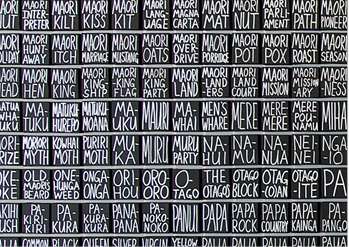
Adam Art Gallery brings rarely seen artworks from Victoria University of Wellington’s art collection into view in its latest exhibition.
Congratulations to the International English Language Testing System (IELTS) team, from the School of Linguistics and Applied Language Studies (LALS), which was nominated for an excellence in customer service award at the recent International IELTS conference.
Poets and scholars from New Zealand, Australia, the UK, Canada and the US came together at Victoria University of Wellington earlier this month for a conference exploring the space where poetry intersects with essay.

Victoria University of Wellington’s eleventh New Zealand Post-Election Conference boasts an impressive programme featuring party leaders, experts and political commentators, who will gather at Parliament for a day-long conversation about the 2017 general election.

Dr James McKinnon, senior lecturer and director of Victoria University of Wellington’s Theatre programme, has won a 2017 national Tertiary Teaching Excellence Award recognising his commitment to innovative and holistic teaching.

A Victoria University of Wellington academic has been awarded nearly $100,000 in funding to research the effectiveness of music therapy for children with Autism Spectrum Disorder (ASD).

Is New Zealand a butcher shop or a milking shed? Do Kiwis live on the sheep’s back with a glass of sauvignon blanc? These and other questions will be addressed when Victoria University of Wellington hosts a series of lively public discussions exploring primary products’ place in the national imagination and how they define us as New Zealanders.